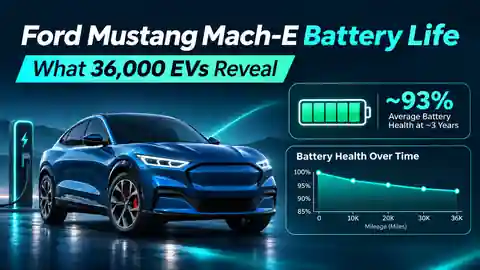
Ford Mustang Mach-E batteries are holding up better than many electric car buyers might expect. New data from Ford shows that approximately 36,000 Mustang Mach-E vehicles from the 2021 model year retained an average of 92% of their usable battery capacity after about five years of ownership.
The findings, published on November 9, 2026, cover more than two billion miles driven across the United States and Canada. They offer an unusually large real-world look at how the Mustang Mach-E battery ages, including vehicles that have traveled more than 100,000 and even 200,000 miles.
For anyone considering a used Mustang Mach-E or wondering how long an electric vehicle battery can last, the results provide useful evidence. However, the figures also need careful interpretation.
What Ford’s Study of 36,000 Mustang Mach-E Batteries Found
Ford examined connected-vehicle battery data from its original 2021 Mustang Mach-E fleet. The vehicles had an average ownership period of 5.2 years, giving the automaker an opportunity to observe how battery health changes during normal use.
According to Ford’s official battery-health report, the average vehicle retained 92% of its original usable battery capacity.
The results become more interesting when we look beyond the average. Ford reported that 95% of the vehicles had battery-health readings between 87% and 97%, suggesting that relatively modest degradation was common across the fleet.
Ford Mustang Mach-E Battery Health by Mileage
| Vehicle group | Reported average battery health |
|---|---|
| Approximately 36,000 vehicles, average ownership 5.2 years | 92% |
| More than 2,000 vehicles exceeding 100,000 miles | Above 91% |
| More than 30 vehicles exceeding 200,000 miles | 88% |
Source: Ford, November 9, 2026. Data collected through August 2026.
The mileage groups are subsets of the broader 2021 fleet, not separate controlled experiments. They should not be interpreted as a precise prediction of degradation at a particular mileage.
One particularly unusual example is David Blenkle, whose 2022 Mustang Mach-E has reportedly traveled more than 400,000 miles on its original battery. His experience helped encourage Ford to examine the much larger 2021 fleet.
Although individual high-mileage examples are interesting, the broader dataset is more useful when evaluating battery durability.
Does 92% Battery Health Mean Only 8% Range Loss?
Not necessarily. Battery health and driving range are related, but they are not identical measurements.
A battery with 92% of its original usable capacity has approximately 8% less usable energy than it originally held. Under otherwise identical conditions, that could translate into a similar reduction in driving range.
Consider a hypothetical Mustang Mach-E originally rated for 300 miles.
If its usable battery capacity declines by 8%, a simplified calculation gives:
300 miles × 0.92 = 276 miles
That represents a theoretical reduction of 24 miles.
However, this is an illustration, not an actual range test. Real-world range also changes with temperature, speed, tire condition, driving style, road elevation, and cabin heating or air-conditioning use.
A vehicle displaying 92% battery health therefore should not automatically be expected to deliver exactly 92% of its original EPA-rated range.
This distinction matters when evaluating older electric cars. Battery-health estimates provide useful information, but they are only one part of understanding how far a vehicle can travel.
How Long Can a Ford Mustang Mach-E Battery Last?
The Ford Mustang Mach-E battery is designed for long-term use, but the exact lifespan of any individual battery cannot be established from a five-year study.
Ford says its battery packs are designed to last at least 10 years. The latest findings offer encouraging evidence from the first five years of ownership, rather than proof that every battery will reach a particular age or mileage.
There is also an important difference between battery degradation and battery failure.
Battery degradation is the gradual loss of usable capacity over time. A battery may lose some range and still operate normally for years.
Battery failure, on the other hand, may involve faults or defects requiring repair or replacement.
A battery does not necessarily need replacing simply because it has lost 8%, 10%, or even more of its original capacity. Replacement decisions depend on performance, condition, faults, owner requirements, and applicable warranty terms.
Independent research provides additional context. Recurrent’s EV battery lifespan research, published in November 2025, found that battery replacements outside major recalls were relatively uncommon in its monitored community, particularly among newer electric vehicles.
Ford’s findings add another substantial dataset to the discussion, although they do not settle the question of lifetime battery durability.
What Does Ford’s Battery Warranty Cover?
Battery warranty protection is particularly important for anyone considering a used Ford Mustang Mach-E.
For U.S. buyers, Ford specifies a high-voltage battery warranty lasting 8 years or 100,000 miles, whichever comes first, with a minimum capacity-retention threshold of 70% during the covered period.
The exact terms and exclusions should always be checked against the warranty documentation for the vehicle’s model year.
That 70% threshold should not be confused with the battery’s expected lifespan. It is a warranty capacity standard, not a prediction that the battery will fall to 70% health after eight years.
For example, a Mustang Mach-E with 85% battery health may have experienced normal degradation while remaining above the capacity threshold associated with warranty coverage.
Ford’s reported 92% fleet average is comfortably above the stated minimum. However, the study does not establish the condition or warranty eligibility of every individual vehicle.
Before buying a used Mach-E, buyers should review its service records, warranty status, battery-health information, and any applicable recalls.
Official warranty information is available through Ford’s Mustang Mach-E vehicle specifications.
What Affects Mustang Mach-E Battery Degradation?
Electric vehicle batteries do not all age at the same rate. Their long-term condition depends on several interacting factors, including temperature, charging habits, battery chemistry, and time.
Battery Temperature and Climate
Excessive heat can accelerate the chemical reactions associated with lithium-ion battery aging.
The Mustang Mach-E uses a battery thermal-management system designed to help regulate temperature. Nevertheless, environmental conditions and usage patterns can still influence long-term battery health.
Parking in shade during very hot weather and using available battery preconditioning features may help reduce unnecessary thermal stress.
Cold weather presents a different issue. Low temperatures can temporarily reduce battery performance and available driving range without necessarily causing an equivalent permanent loss of capacity.
Charging Habits
Charging behavior can also influence battery aging.
Ford recommends using Level 2 charging for everyday driving when possible and relying on DC fast charging when it is useful for longer journeys.
Drivers should also follow the charging guidance provided for their particular vehicle and battery chemistry.
For readers unfamiliar with home charging and charging speeds, our guide to electric vehicle charging times explains how different charging methods work and why charging time varies.
Battery Chemistry
The 2021 Mustang Mach-E vehicles covered by Ford’s study used nickel-cobalt-manganese (NCM) batteries.
Some later Ford EVs introduced lithium iron phosphate (LFP) battery chemistry, which has different charging and battery-management characteristics.
Ford notes that certain LFP batteries benefit from occasional charging to 100% to help the battery-management system maintain accurate calibration.
That does not mean every Mustang Mach-E should routinely be charged to full capacity. Owners should use Ford’s current model-specific recommendations instead of applying one universal charging rule.
What the Study Cannot Tell Us
Ford’s findings are encouraging, but the research has limitations that deserve attention.
First, the figures come from Ford’s own connected-vehicle data. Battery state of health was estimated through the vehicles’ onboard systems rather than independently measured through controlled laboratory capacity tests on all 36,000 batteries.
Second, the results concern 2021-model-year Mustang Mach-E vehicles. They should not automatically be applied to every later model or different battery chemistry.
Third, averages do not describe the condition of every individual vehicle. Some batteries retained more capacity than others.
Finally, the study represents approximately five years of ownership. It cannot independently confirm how those same batteries will perform after 10 or 15 years.
Ford also did not provide a comprehensive public battery-replacement rate for the study cohort.
These limitations do not invalidate the findings. They simply establish what the reported numbers can and cannot demonstrate.
For a useful broader comparison, the U.S. Department of Energy’s analysis of EV battery replacements discusses replacement patterns across earlier plug-in vehicle model years.
Should You Buy a Used Ford Mustang Mach-E?
Ford’s latest battery-health findings provide a positive signal for used Mustang Mach-E buyers, particularly those concerned that EV batteries will rapidly lose capacity after a few years.
However, a good fleet average is not a substitute for checking the particular vehicle you intend to purchase.
An older Mach-E with reasonable battery health, consistent maintenance records, and an appropriate purchase price may deserve serious consideration. Its remaining driving range should still match your daily commute, occasional long-distance trips, and access to charging.
Battery condition is only one part of the buying decision. Buyers should also review accident history, tires, suspension, charging equipment, software updates, repair history, and remaining warranty coverage.
A vehicle that looks attractive on paper may still require closer inspection, particularly if it has experienced unusual operating conditions or has incomplete service records.
For readers comparing Ford’s electric vehicle lineup, Future Flux Tech has also covered the Ford F-150 Lightning and its position in the electric pickup market.
The Bottom Line: Ford’s Battery Data Is Encouraging
The biggest finding from Ford’s 36,000-vehicle Mustang Mach-E study is straightforward: after approximately five years, the average 2021 vehicle retained 92% of its usable battery capacity.
Even the higher-mileage groups reported substantial remaining battery health, providing useful evidence that many modern EV batteries can remain functional well beyond the first several years of ownership.
The results do not guarantee that every Mustang Mach-E battery will last a particular number of years or miles. They do, however, make it harder to assume that substantial battery degradation is inevitable early in an EV’s life.
For current owners, the practical takeaway is to follow the vehicle’s charging and maintenance recommendations. For used-EV buyers, the right approach is to combine encouraging fleet-wide research with a careful evaluation of the individual car.

I’m Waqas, an electric vehicle enthusiast and tech writer with over 6 years of experience covering the EV industry. I write in-depth articles, comparisons, and reviews to help readers understand the fast-evolving world of electric mobility. From battery technology to EV launches and charging trends, I aim to make complex EV topics simple, engaging, and informative for everyday drivers and curious readers alike.